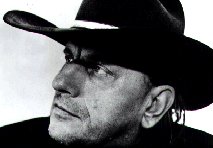
Welcome
on this site,
where you can meet
the Dutch blueslegend
Harry (Cuby) Muskee.
and his band
CUBY & THE BLIZZARDS

NEW RELEASES 2003-2006
Mamelodi: C+B did a succesfully trip
to South Africa.In Joburg en Pretoria a
dvd is recorded in a township with 5 camera's and 24 tracks
music. Mayby, a movie from this trip is added. The benefit of this
DVD in South Africa is for the Aidschildren in the Cotlands hospital.
The release in South Africa is March 2003, in Holland September
2003.
Harry Muskee (His Youth)
Harry Muskee was born on the 10th of June 1941 in Wilhelmina
Hospital in the Dutch town of Assen. After having lived in
Rotterdam for a few years ( his father was a marinier), Harry
returned to Assen, when he was six. His mother had multiple
sclerose, she became disabled. Harry was her only child. He was
in the neighbourhood of his mother as often as possible to take
care of her. After her death, he grew up with his grandmother. He
lived in the Lodewijk Napoleonstreet and visited
Noordersingelschool. On his tenth birthday he became a member of
the footballclub VV. "Achilles" and played volleyball
with "Tornado". So he was a sportsmanlike boy.
His musical career began in the sixties as a partime-singer and
bassplayer of a Dixielandband "The Old Fashioned Group" . Harry Muskee
was very interested in and knew much of jazz and became
blues-"mad" American Forces Network (for American
soldiers, armed in Germany) and The Voice of America were his
favourite radiochannels.
1955-1964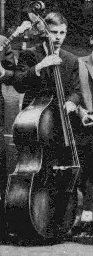
Harry Muskee and Eelco
Gelling are the foundation of Cuby & The Blizzards. As
singer and guitarist of The Mixtures, Harry performs songs of The
Everly Brothers and other bands, before playing the contra bass
in the Old Fashioned Jazz Group. (see also the guestpage) Harry is first introduced to jazz
and blues through listening to the American discjockey
Wilis Conover from the army stations like American Forces Network
and The Voice of America on an old radio
Eelco Gelling is guitarist in the Rocking Hurricanes, later The
Rocking Strings, with Hans Kinds (rhythm guitar), Wim Kinds
(Drums) and Nico Schröder (bass). Their repertoire mainly
consisted of Shadow-instrumentals and the group even made two
records: "Autumn Leaves" and an EP "Black
Rock". The musicians meet each other on a stage in Drenthe
and it is only a matter of time before Harry starts singing Elvis
Presley covers with the Rocking Strings.
In 1964, Willy Middel (bass, ex-Sinister Silhouettes) replaces
Nico Schröder, who is not allowed to play on Sundays. After Dick
Beekman (drums) replaces Wim Kinds, Harry Muskee completes the
line-up .
1965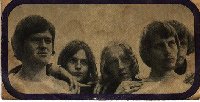
The Rocking Strings
become Cuby & The Blizzards. ‘Cuby’ after the
neighbour’s dog, and ‘Blizzards’ is randomly
picked out of an English dictionary. It is the start of a
legend. Muskee and Gelling take the musical lead and introduce
Holland to the blues: music with emotion.
"Cuby and the Blizzards"
Singer Harry (“Cuby") Muskee and leadguitarist
Eelco Gelling, both working (as a reporter and a photographer)
with a local newspaper in Assen, a town in the Northern part of
Holland and the other members Dick Beekman (drums),Willy Middel
(bas), Hans Kinds (beatquitar) of the band were forced to turn
professional after one year as three of the boys were fired,
because of their long hair.
As the five excellent musicians refused to do any commercial
types of music, they struggled almost three years for
recognition. Their music is highly influenced by the Chicago
blues. Most of their tunes have been composed by Harry Muskee and
Eelco Gelling, though the group also recorded songs by a.o. John
Lee Hooker, Elmore James, Eddie Boyd and Lightnin' Hopkins.
One afternoon, Cuby & The Blizzards record ‘Stumble
and Fall’ and ‘I’m So Restless’ (CNR), live
and without any overdubs. The songs do very little, but locally
Muskee becomes a hero. The band’s hard core of fans paints
the band name on walls everywhere, following the band across the
northern provinces on motors and bikes.
The first international performance of Cuby & The Blizzards
is in 1965. They perform at a local dancing in Marderno, near the
Garda lake in Italy, mainly for German and Dutch tourists.
Italian band Gli Uragani covers the Cuby & The Blizzards
song ‘Your Body is not Your Soul’. Their version, ‘Vuoi arrivare su’, reaches the
number 6 position in the Italian charts.
"Cuby
and the Blizzards"
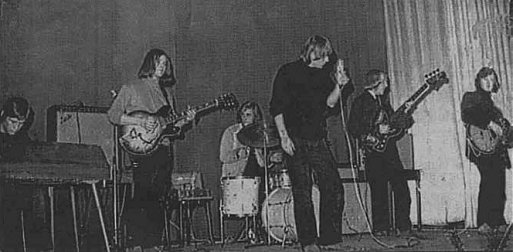
v.l.n.r. Herman Brood, Eelco
Gelling, Hans Waterman, Harry Muskee, Willy Middel and Hans Kinds
(Rudy Leukveldt)
1966
The following single is ‘LSD’ (Got a Million Dollar), a
song by Manfred Mann’s Tom McGuiness. NCRV radio boycots the
song. The B-side is ‘Your Body not Your Soul’, one of
Harry Muskee’s first songs. The single ‘Back Home/Sweet
Mary’ enters the Dutch Top 40. Drummer Dick Beekman joins
the Ro-d-ys from Winschoten and is replaced by seventeen-year-old
Hans Waterman (The Rene
Five).
Cuby & The Blizzards record their first album Desolation. The title
comes from the book ‘Desolation Angels’ by Jack
Kerouac, one of the leaders of the beat generation, who is very
influential on the artistic Dutch youth as well. It is the first
Dutch blues album and draws the attention of Willem de Ridder,
editor-in-chief of Hitweek.
Harry’s farm in Grolloo becomes a place of pilgrimage. Ton
Sybrands, Simon Vinkenoog, Boudewijn de Groot, Johnny the Selfkicker, John
Mayall, Eddie Boyd, and Alexis Korner all sleep
at Harry’s farm. A ‘road to fame’ in Grolloo
reminds us of the many, often eccentric, visitors. Single
‘Just for Fun’ is a tribute to the village and its
inhabitants. a small village called Grollo (population: 500)
situated in one of the most isolated parts of Holland.
A young piano player called Herman
Brood (ex-Moan) joins the band. Moan regularly performs for
American soldiers in Germany, always an exhausting experience. To
keep it up they swallow pep pills given to them by the Americans,
and Brood turns it into a lifestyle.
1967
Cuby & The Blizzards reaches the top position in music
magazine Hitweek, followed by performances both in and outside
Holland, from Oosthesselerbrug to Brussels, from The Hague to
West Berlin, from Prague to London. But fame takes its toll: Hans
Kinds and Willy Middel leave the band. Jaap van Eik (Blues
Dimension) is the only replacement on bass. The legendary album Groeten uit Grollo
is released, featuring Herman Brood, Jaap van Eik and Hans
Waterman.
Eddie Boyd (1914) may be the first black man in Grolloo. This
legendary blues singer (coming from the same cotton plantation as
Muddy Waters) from the Mississippi Delta is one of the first
black American blues singers traveling to Europe. In 1966, during
his UK tour with John Mayall and the Bluesbreakers, both end up
at Cuby’s farm in Grolloo. This first personal meeting with
the black blues singer results in the Eddie Boyd and the
Blizzards album Praise
the Blues, which is followed by a tour.
This is followed by a 3-day Dutch tour (5 gigs) with Irish singer
Van Morrison (Them). The arranged recording is cancelled at the
last minute. The broadcast museum at the Mediapark in Hilversum
still has a black and white comedy capers-like clip of Van
Morrison and the Blizzards.
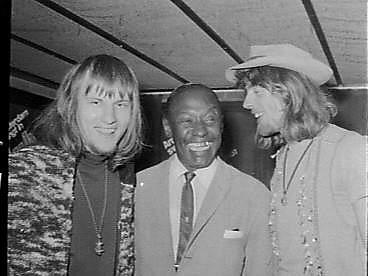 |
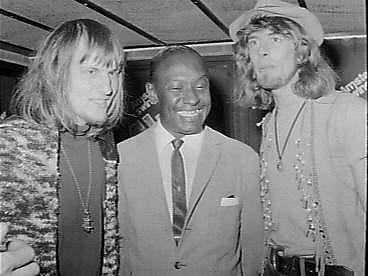 |
| Harry Muskee,
Eddy Boyd, John Mayall |
Harry Muskee,
Eddy Boyd, John Mayall |
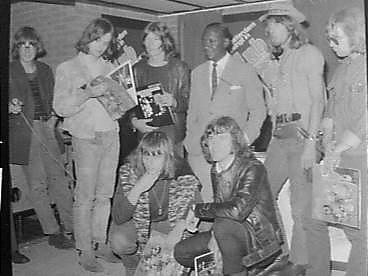 |
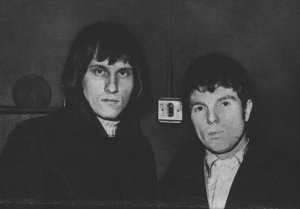
|
Eelco Gelling,
Herman Brood,
Eddy Boyd, John Mayal, Dick Beekman
Harry Muskee en Jaap van Eik |
Harry Muskee
with Van Morrisson |
Het jaar
1967 mag voor Muskee c.s. extra succesvol genoemd worden. In dat
jaar ontving de groep namelijk uit handen van Wim Sonneveld een Edison. Een onderscheiding, die nog geen enkele groep uit dit
muziekgenre had mogen ontvangen. Hoewel bluesmuziek nooit
doorgedrongen was tot het commerciële circuit, slaagde Muskee er
met zijn band in zo populair te worden, dat de, door de groep
uitgebrachte, singles tussen 1996 en 1971, maar liefst negen keer
voorkwamen in de top 40 van de meest verkochte platen.
Click here
to watch a movie, a time-impression from the Drents Audiovisueel archive.
(dutch spoken)
1968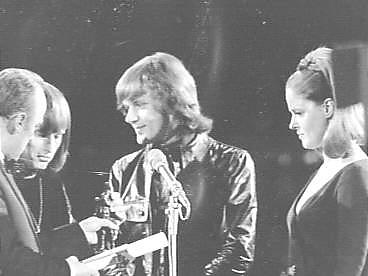
Edison
The album Desolation
is awarded with an Edison at the Grand Gala du Disque, presented
to the band by Wim Sonneveld.
v.l.n.r. Wim Sonneveld, Harry Muskee, Hans Kinds ??
In November, the band performs at
the Jazz and Blues festival in the Rheinhalle in Düsseldorf for
3000 people, a shared performance with The Spencer David Group.
Dick Beekman returns and takes over from Hans Waterman. The album
Live in Düsseldorf
is recorded with a four-track recorder. Alexis Korner, founder of
the English blues, is guest performer on two tracks. Alexis lives
in London at Paddington 116a, Queensway, hence the single
‘Queensway 116a’, the B-side of ‘Nostalgic
Toilet’ which enters the Top 40. In December the band
performs in Prague.
With a line-up featuring Muskee, Gelling, Van Eik, Brood and
Beekman, Cuby & The Blizzards record the album Trippin’ thru’ a
Midnight Blues, with the horn section of Eduard
Ninck-Blok, Roel Hemmes and Jenne Meinema, their buddies from the
northern music scene. The single ‘Window of my Eyes’ is
in the Dutch Top 40 for ten weeks, and is considered to be the
band’s most important song.
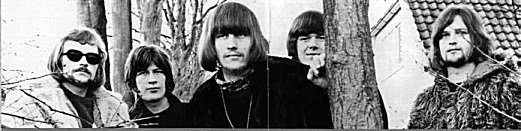
v.l.n.r. Dick Beekman, Herman Brood, Harry Muskee, Jaap van Eik, Eelco Gelling,
Cuby & the Blizzards became one of the most wanted groups in
Europe in these years.The group played on International Festivals
in Plumpton (England), Essen, Dusseldorf, Frankfurt (Germany),
Prague (Czechoslovakia), Bilzen and Turnhout (Belgium). At these
Festivals Cuby & the Blizzards were on stage with top-groups
like The Fugs, The Nice, John Mayall, Fleetwood Mac, The Mothers
of Invention, The Spencer Davis Group, The Small Faces, Jimi
Hendrix Jeff Beck, Jethro Tull, etc. After the first British tour
( October 3-13 '68), the group also toured in Sweden, Poland,
Belgium and Germany. Cuby & the Blizzards made a second tour
in England from On stage they produced exactly the sound as
on record. All members are much-beloved session-men for
recordings, radio and TV. As a group they accompanied a.o. Van
Morrison, John Mayall, Alexis Korner and Eddie Boyd. Cuby &
the Blizzards is one of the few continental groups, capable of
making a great impact in England and the US.
 1969
1969
In the spring, Cuby & The Blizzards are on tour in Holland
with Fleetwood Mac and in August 8-16-'69.they visit the UK
for the very first time (where they perform at the famous London
Marquee Club). At the end of 1969 the band scores with the single
‘Appleknockers Flophouse’, featuring Helmig van der
Vegt (Blues Dimension), who replaces Herman Brood.
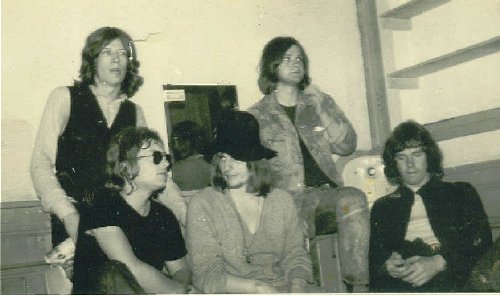
v.l.n.r. Herman Brood, Dick
Beekman, Harry Muskee, Eelco Gelling, Jaap van Eik
1970
Once again there are some changes in the line-up: Jaap van Eik
joins Trace, and Dick Beekman joins Livin’ Blues (this time
leaving for good). Herman Brood quits as well, the reason being
his arrest in The Hague for possession of drugs. Exit Herman
Brood, and exit the planned trip to the US. The "Zwolle
connection", consisting of Herman Deinum, Hans
Lafaille and Helmig van de
Vegt (all ex-Blues Dimension), joins Cuby & The Blizzards.
The album Appleknockers
Flophouse is released. The album cover design causes a
true media riot. Cees Wessels and Anton Witkamp (label manager
and copywriter at Phonogram/Polygram) came up with a publicity
stunt. They invited a number of farmers from the area of Wezup at
Willem Perkaan’s bar (‘Vat Op Klomp’n’) for a
cover photo session with the band. There was free food and drinks
for all, and when the farmers were reasonably drunk, Cees Wessels
brought in a stripper, who did her strip act on the bar, a
sensation in those days. The farmers loved it. But when they
sobered up the next day and discovered that the whole thing was
photographed and filmed, they panicked. The mayor of Zweelo took
up arms "to protect his citizens from a scandal". So,
the pictures were not allowed to be used. Thus, the album cover
contains only the, very cheerful, band. The film, made by the
VARA, has never been broadcast, despite frantic efforts to
retrieve it.
1971
Cuby & The Blizzards do a two-week tour in Poland with
performances in Warsaw, Katowice and Poznan. At the end of the
year the band supports BB King at the Amsterdam Concertgebouw.
Following the successful sixties, the early seventies are a bit
of a disappointment. Planned tours in the US, the UK and
Scandinavia are cancelled, and there are disputes with managers.
Harry Muskee and Eelco Gelling withdraw to an apartment in Assen
and go back to basic. Cuby & The Blizzards still release the
album Simple Man,
for which Harry writes all lyrics. It is the story of an ordinary
guy from a small town, middle class neighbourhood, who wants to
make his own music without having to make any commercial
concessions.
1972
Sometimes is
released, the band’s last and very jazzy studio album. The
chemistry between Muskee and Gelling diminishes. Four out of nine
songs are written by Helmig van de Vegt, and only two songs by
Muskee/Gelling. Shortly after the album is released the band
breaks up, right before a gig in Munster. The cause is a minor
communication problem, but it is the famous last drop with
serious consequences. There are problems at the border with the
equipment truck because of a missing passport. Harry and Eelco
return home. But the guys from Zwolle, unaware of the situation,
continue traveling to the venue. As a consequence, the band falls
apart. On June 14th both Muskee and Gelling apply for
social benefits in Assen.
1973
The band performs in its original line-up twice, one time on June
9th during a farewell concert in a sold-out
Concertzaal Bellevue in Assen, with Harry Muskee, Eelco Gelling,
Willy Middel, Hans Kinds, Herman Brood and Jaap van Eik. Guest
performers are Wim Ennes, Henk Nahrendorf and Hans Waterman.
1974
On January 15th,the band records a farewell album in the
studio where they perform at the VARA TV show Nederpopzien, with
Harry Muskee, Eelco Gelling, Hans Kinds, Willy Middel, Hans
Waterman and Herman Brood.
Click here
to watch a movie, a time-impression from the
Drents Audiovisueel archive. (dutch spoken)
Touched up: 24-02-2009
Something
about myself (in Dutch)
(c) 1996 These pages are kept up by Dick Bron